
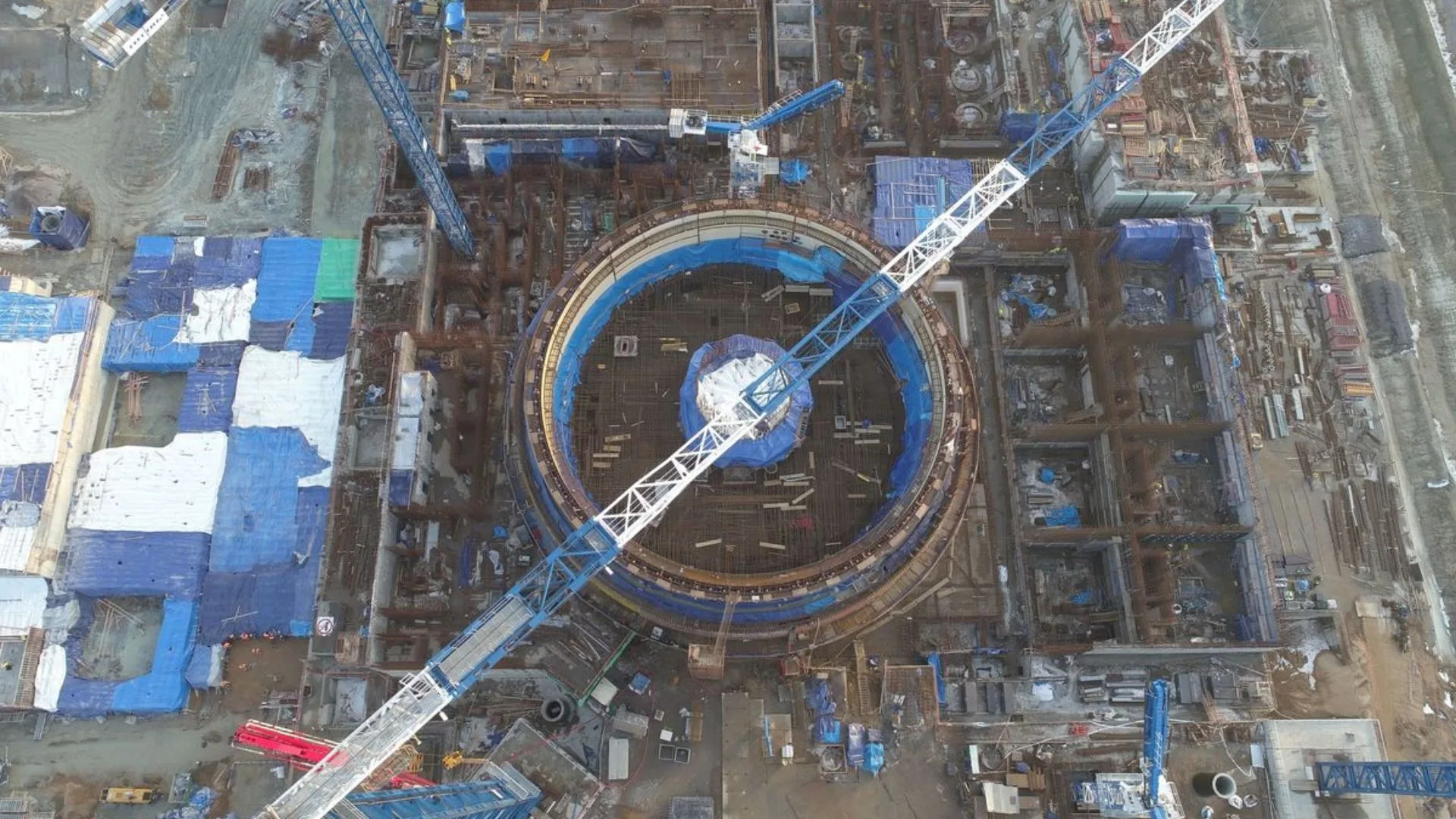
At the Leningrad-2 Nuclear Power Plant, the installation of the second level of the inner containment vessel (ICV) system was successfully completed in the reactor building of Unit 3 VVER-1200. This structure is part of a double containment system, one of the most advanced safety elements in the design of Russian nuclear reactors.
The reactor building has already reached 22 meters of the planned 70 meters in height, following the installation of a 260-ton section. The complete structure is expected to be ready in 2028, meeting the highest engineering and protection standards against extreme conditions.
Strategic importance for the region
During an official visit on March 11, 2026, the Director General of Rosatom, Alexey Likhachev, together with the Governor of the Leningrad region, Alexander Drozdenko, inspected the progress of the project, which is considered essential for the energy development of the Russian Northwest.
During the tour, Likhachev highlighted that this northwestern region of the country is traditionally energy-intensive, with constantly developing industrial and port infrastructure. Currently, the Leningrad and Kola nuclear plants provide more than 35% of the electricity consumed by the region, with a combined capacity exceeding 6,000 MW.
With more than 5 decades of operation, these plants are in a technological renewal process. Units 3 and 4 of Leningrad-2 will replace the old RBMK-1000 reactors, ensuring the supply of clean electricity for at least another 60 years.
Workforce and quality control
Approximately 1,500 specialists from the Titan-2 Holding group, the project’s general contractor, are working on-site. Current tasks focus on the so-called “nuclear islands,” the starting point of the entire generation chain, where each installation phase is under strict supervision by the client, the contractor, and state inspection bodies.
Stable supply with sustainable development
For his part, Governor Alexander Drozdenko stated that the project will guarantee a continuous supply of electricity for millions of citizens, as well as the continuity of key investment and infrastructure projects.
The construction of these new nuclear units is part of a national strategy to modernize energy infrastructure, reduce polluting emissions, and strengthen the country’s energy independence.
Source and photo: Rosatom