
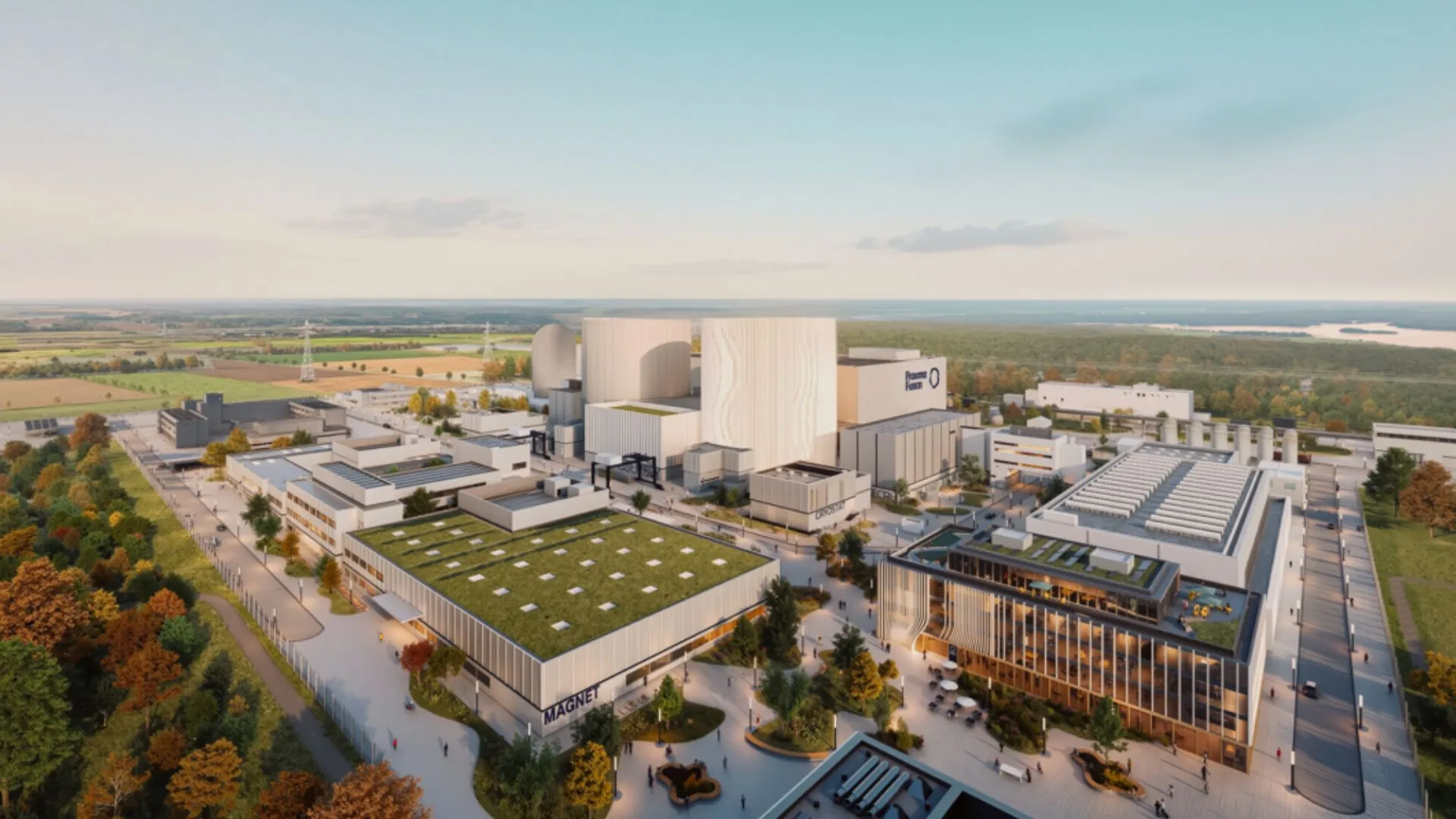
Germany has taken a major step toward the energy future with the signing of a memorandum of understanding between Proxima Fusion, RWE, the Max Planck Institute for Plasma Physics, and the Free State of Bavaria, establishing the roadmap to develop the world’s first commercial fusion power plant based on stellarator technology.
Construction in 2 stages: Alpha and Stellaris
The first step will be the construction of Alpha, a demonstration reactor to be located in Garching, near the Max Planck Institute, which will be the first stellarator designed to demonstrate net energy gain—meaning it will generate more energy than it consumes. It is expected to be operational in the 2030s.
The next step will be the construction of Stellaris, a commercial fusion power plant to be built on the site of a former nuclear fission plant in Gundremmingen, currently being decommissioned by RWE.
Science, engineering, and energy policy united
The project reflects unprecedented coordination between elite research, advanced engineering, and state commitment.
- Proxima Fusion will lead the engineering, procurement, and construction.
- The IPP, a world leader in stellarators, will take on the scientific direction and plasma research.
- RWE will provide operational expertise and infrastructure.
- The State of Bavaria will facilitate regulatory processes and part of the funding.
It is estimated that 20% of the total cost will be covered by private investors, and Bavaria has proposed an equivalent state contribution, pending federal support.
An industrial ecosystem under construction
As part of the agreement, the formation of the Alpha Alliance has also been announced—a consortium of more than 30 European and international companies that will participate in the manufacturing, integration, and validation of critical technologies for the project’s development.
The initiative is expected to generate thousands of direct and indirect jobs, including the creation of a specialized magnet plant that could employ up to 1,000 people in Munich.
Fusion as a European energy strategy
The fusion power plant not only aims to provide CO₂-free electricity but also to reduce external energy dependence and consolidate a sustainable, continuous, and scalable alternative to power industries, data centers, and critical infrastructure.
With this initiative, Germany seeks to turn a scientific promise into a tangible project. With Garching and Gundremmingen as epicenters, the continent is moving toward a new energy model driven by fusion technology and international collaboration.
Source and photo: Proxima Fusion