
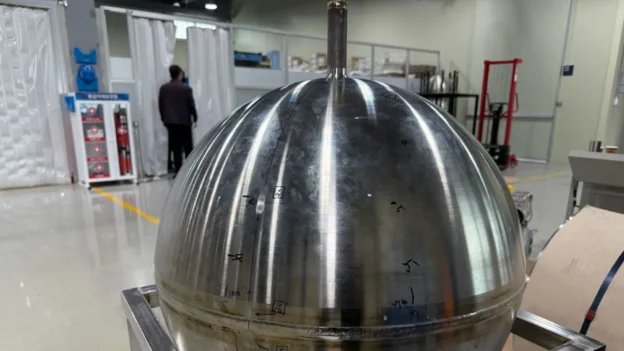
A South Korean team has validated that a titanium alloy cryogenic pressure vessel manufactured by 3D printing can operate reliably in extreme cold and high pressure conditions.
3D printing of a cryogenic pressure tool
The Korea Institute of Industrial Technology(KITECH) and the Korea Advanced Additive Manufacturing Center(KAMIC), together with the Korea Aerospace Research Institute (KARI) and industrial partners, built a 130-liter, 640-mm diameter tank using a Directed Energy Deposition process with laser and metal wire. The choice of Ti64 titanium was based on its mechanical strength, low weight and thermal stability.
For fabrication, the hemispherical halves were produced layer by layer with real-time quality control and deposition optimization. After heat treatment and precision machining, the parts were joined together to form a monolithic vessel capable of withstanding spatial operating pressures.
The cryogenic test, performed by KARI, consisted of cooling the tank to -196 °C with liquid nitrogen and gradually increasing the internal pressure to 330 bar. In addition, sensors and high-speed cameras confirmed that the structure responded exactly as predicted by the analysis models.
This result opens the door to more efficient and lighter designs in space launch vehicles. space launch vehicles and satellites and satellites, eliminating limitations of conventional molding and forging. The team plans to expand testing with pressure cycling and move toward certification for real missions.
Source and photo: KAMIC