
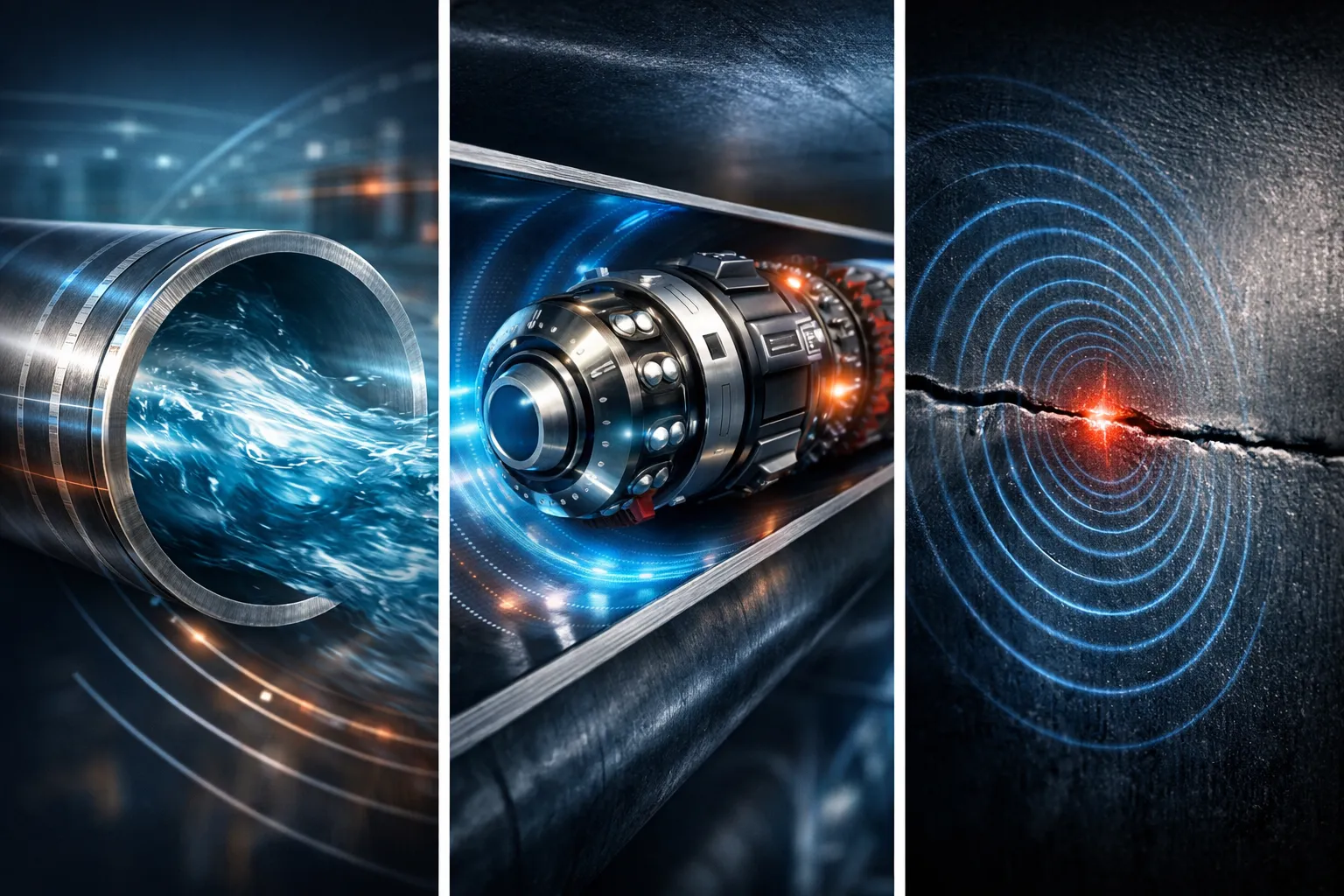
Carbon Capture, Utilisation and Storage (CCUS) is a pivotal step towards developing a sustainable energy landscape while lowering carbon footprint and adopting a circular economy model. A key enabler within this framework is CO2 pipeline transportation, which connects emission sources to storage or utilization destinations, weaving the structural backbone of a scalable CO2 value chain.
A key component of many CCUS initiatives is the creation of industrial clusters. These hubs are designed to collect CO2 emissions from multiple facilities and channel them through shared infrastructure for transportation and long-term storage. Central to this vision is a reliable network of CO2 pipelines capable of safely moving captured carbon to designated storage sites.
Historically, CO2 pipelines, mainly developed in the U.S. between the 1970s and 1990s, were engineered to transport nearly pure CO2 derived from natural gas processing. Today’s CCUS landscape presents a more complex challenge: transporting anthropogenic CO2 from industrial activities, which often contains moisture in addition to a diverse mix of impurities such as sulphur oxides (SOx), nitrogen oxides (NOx), hydrogen sulphide (H2S), hydrogen (H2), and carbon monoxide (CO).
This impurity profile is especially relevant in processes like blue hydrogen production, where CO2 is captured as a by-product of steam methane reforming. In such cases, hydrogen contamination in the CO2 stream is likely, introducing new technical hurdles.
These evolving conditions demand advanced pipeline design and operational strategies to mitigate risks associated with corrosion, environmentally assisted cracking (EAC), and fracture control. Ensuring safe and efficient CO2 transport under these circumstances requires a multidisciplinary approach, integrating pipeline integrity engineering, materials science, fluid dynamics, and predictive modeling to support long- term infrastructure resilience and climate goals.
Operating CO2 pipelines in the supercritical zone
As the world intensifies efforts to combat climate change, CCUS technologies are gaining momentum. At the heart of this commitment lies a deep dedication to sustainability, innovation, and long-term impact, driving every decision, investment, and technological advancement toward a cleaner, more resilient future, but more importantly a complex engineering challenge: transporting carbon dioxide in its dense phase or supercritical state through pipelines. This isn’t just a technical feat, it’s a frontier of innovation.
When CO2 is compressed beyond its critical temperature and pressure, 31.1 °C and 7.38 MPa, respectively, it enters a supercritical state. In this dense phase, it behaves like both a gas and a liquid, offering high density for efficient transport while maintaining fluidity. This makes supercritical CO2 ideal for long-distance pipeline transmission, especially in large-scale CCUS networks.
However, operating in this dense-phase envelope introduces unique risks and demands. Supercritical CO2 is highly sensitive to temperature and pressure fluctuations, which can lead to phase changes, pressure surges, and unpredictable flow dynamics. The fluid’s corrosive potential also increases, particularly in the presence of water or impurities, posing threats to pipeline integrity.
Electromagnetic acoustic transducer ILI technology – RoCD EMAT-C Ultra
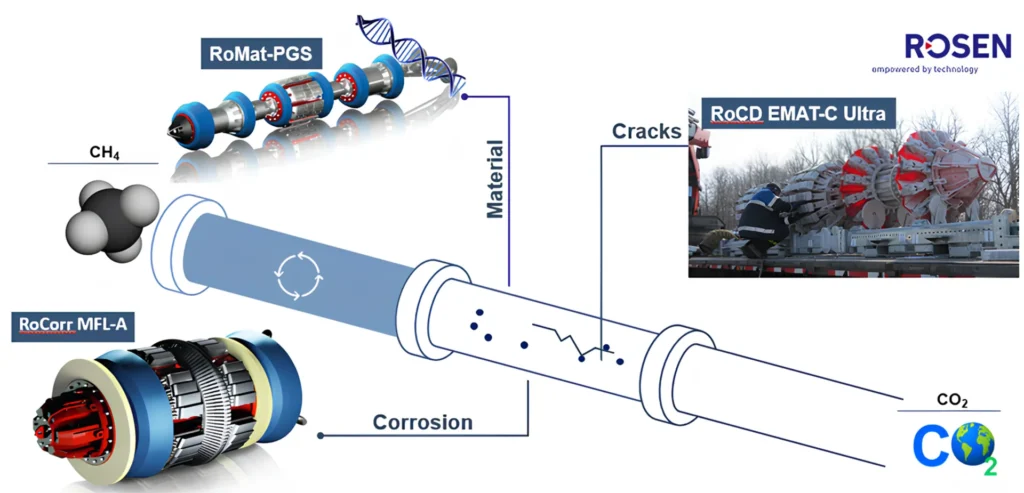
In the ongoing pursuit of pipeline safety and reliability, advanced detection of axial cracks, such as those caused by stress corrosion cracking, is critical. Newly developed RoCD EMAT-C Ultra technology introduces a breakthrough in in-line inspection, offering ultra- high-resolution crack detection and sizing capabilities. With sensors strategically overlapping to achieve 200% coverage across the pipe body and longitudinal welds, the system delivers a remarkable 95% probability of detection for cracking, including flaws as small as 20×2mm.
The technology scans clockwise and counterclockwise, ensuring comprehensive anomaly identification, and excels in detecting both internal and external radial and longitudinal cracks, even those terminating in weld beads. Designed for pipelines with lower bound toughness, EMAT-C Ultra simplifies integrity assessments while reducing the need for costly field verifications or excavations. Its compatibility with CO2 and hydrogen pipelines further positions it as a future-ready solution, combining precision, efficiency, and cost-effectiveness in one powerful inspection technology.
ROSEN’s EMAT data evaluation leverages artificial intelligence using deep learning and pattern recognition to enhance anomaly classification accuracy. The Consistency Check process is trained on high-quality labeled datasets to assess features near decision boundaries, such as distinguishing cracks from non- cracks. Each feature receives a “crack score,” reflecting its similarity to known crack patterns. To reduce false positives and negatives, features with unexpected scores are systematically re-evaluated, ensuring reliable and consistent integrity assessments.
Ultra-high-resolution inspection redefines pipeline safety
In the race to build and maintain safe, efficient carbon dioxide transport networks, one innovation is setting a new benchmark: ultra-high-resolution in-line inspection. With the stakes higher than ever, detecting even the smallest sign of internal corrosion is no longer optional, it’s essential.
ROSEN’s MFL-A Ultra Service is leading the charge. This advanced magnetic flux leakage (MFL) technology offers unprecedented accuracy, capable of identifying pinhole defects as small as one millimeter in diameter. It doesn’t just detect corrosion, it maps its exact structure, revealing complex morphologies that traditional methods often miss.
What sets this service apart is its integration of machine learning and Finite Element Modeling (FEM), which transforms raw data into actionable insights with remarkable precision. The results and benefits include fewer unnecessary excavations, more confident integrity assessments, and a smarter approach to pipeline integrity management.
The MFL-A Ultra Service offers advanced pipeline inspection capabilities with key advantages including highly accurate early detection and sizing of metal loss, reducing unnecessary excavations and associated costs. It integrates Artifical Intelligence (AI) and Finite Element Modeling (FEM) for precise data analysis and enables multi-threat detection, corrosion, erosion, and deformation, in a single run. Its flexible tool design navigates complex pipeline geometries, maintains flow during inspection, and achieves a 95% first-run success rate.
As CO2 pipeline network evolve to meet the increased demand of CCUS, advanced technologies like MFL-A Ultra are not just innovations, they’re enablers and safeguards for the future. With ultra-high-definition sensors and intelligent data processing, operators can now see deeper, act faster, and protect infrastructure with confidence.
Conclusions
ROSEN pioneers solutions to CCUS systems and CO2 pipelines challenges encompasses from advanced inspection technologies to predictive modeling, with the common denominator to protect the asset, people, and the environment, helping operators maintain integrity management over pipelines operating in the supercritical zone. Technologies such as high-resolution in-line inspection and machine learning-driven integrity assessments are redefining what’s possible in CO2 transport.
Operating in the dense phase CO2 supercritical envelope isn’t just about technical excellence, it’s about enabling a scalable, safe, and sustainable CO2 emissions management infrastructure. As nations set aggressive climate targets, the ability to move CO2 efficiently and securely will be a cornerstone of global decarbonization efforts. In this high-pressure CO2 environment, innovation isn’t optional, it’s essential.
This article was developed by specialist David Bastidas and published as part of the seventh edition of Inspenet Brief February 2026, dedicated to technical content in the energy and industrial sector.