
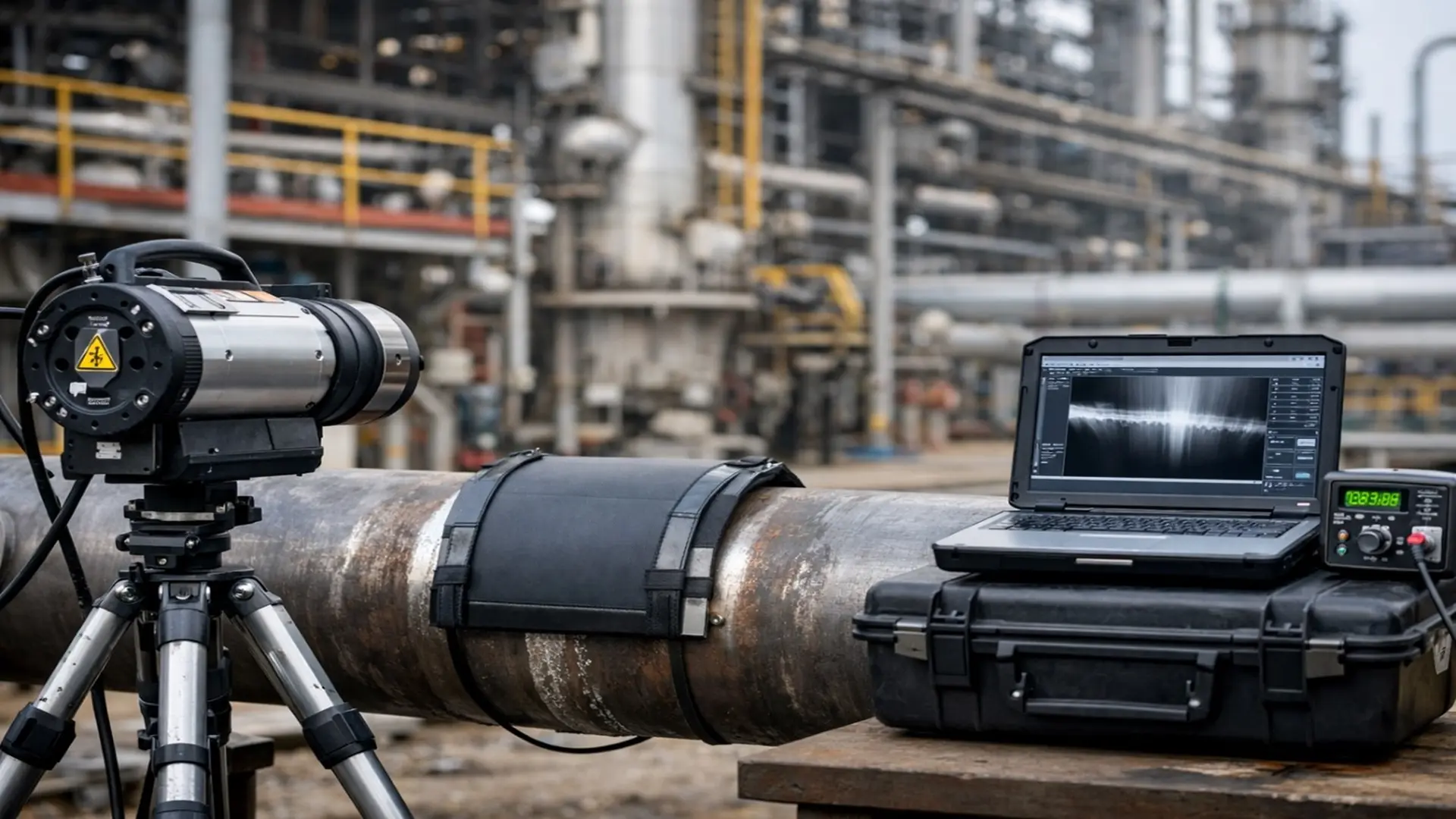
Radiographic testing represents one of the most widely used NDT (Non-Destructive Testing) techniques in QA/QC due to its ability to provide traceable evidence of the internal condition of welds and critical components. In industrial environments, a minor discontinuity can lead to leaks, unscheduled downtime, or safety incidents; therefore, radiography maintains a vital role.
With NDT radiography, radiographic testing has evolved by incorporating image acquisition and workflow software that improve efficiency, portability, and document control. For this advancement to be effective, it is essential to understand system performance and validate quality using Image Quality Indicators (IQI) and the ASTM E747 standard.
Challenges in the Energy and Industrial Sectors
In the energy and industrial sectors, mechanical integrity competes with short maintenance windows, aging assets, and demanding audits. Consequently, this technique is used as evidence for the release of welds, repairs, and critical components.
In most cases, the problem is not a lack of technology. The true challenge lies in variability: changes in technique between crews, unstable geometries, non-uniform evaluation criteria, and incomplete records. When this variability enters the process, the impact is immediate: exposures increase, rework is required, and decision-making is slowed down by acceptance disputes that could have been avoided.
Industrial Radiography in Critical Assets
Industrial radiography allows for the evaluation of internal discontinuities where other techniques might require complex access or provide different types of evidence. This is why it is used for welds, castings, and repair verification. In welding, the radiographic technique is typically robust for volumetric discontinuities such as porosity and inclusions. It can also reveal lack of penetration or lack of fusion, depending on the geometry and arrangement.
There are limits that must be stated. Certain fine or unfavorably oriented cracks may have a low probability of detection if the setup is inadequate. In such cases, inspection is optimized through changes in geometry, additional projections, or complementary techniques.
Real Detection and Process Control
Detectability depends on energy, geometry, scatter, mounting stability, and evaluation criteria. An “aesthetic” image is not necessarily a valid shot. If sensitivity and repeatability are not demonstrated, the radiographic method loses its technical value, even if the image looks flawless.
X-ray NDT: Critical Variables and Typical Failures
X-ray NDT is defined by essential variables that control contrast, sharpness, and repeatability. If these are not governed, results will vary by operator or configuration, and the outcome loses consistency.
Energy, geometry, and dispersion
Energy (kV) affects contrast and penetration. Too high energy can flatten contrast. Too low energy can increase noise or compromise penetration.
Geometry defines sharpness and distortion. Poor mounting degrades the image, even if the equipment is high-performance, and dispersion reduces contrast and can hide details. Controlling this through collimation and technique is part of the performance of the testing technique.
Common errors in digital radiography
A common mistake is to rely on “fixing with software” what was a problem of geometry or technique. Another mistake is to allow uncontrolled display adjustments, leading to different interpretations.
A third mistake is to close the job without a robust file. If the record does not include sufficient traceability, the radiographic test becomes difficult to audit and compare.
Radiographic testing equipment and digital radiography
Radiographic testing equipment must be evaluated as a system: generation (X-rays or gamma rays), detection (CR or DR), and management (software, archiving, and reporting). Productivity improves when the process becomes stable and rework is reduced.
In digital radiography, control shifts to procedure, sensitivity verification, and post-processing governance. A stable radiographic test reduces rework and speeds up releases.
CR and DR with controlled adoption
CR offers flexibility in the field and requires scanning. DR delivers almost immediate images and promotes productivity. In both cases, it is advisable to define minimum quality criteria, roles (capture, evaluation, approval), permitted post-processing, and archiving rules. This foundation reduces variability and improves the consistency of the trial.
Image quality indicator: sensitivity
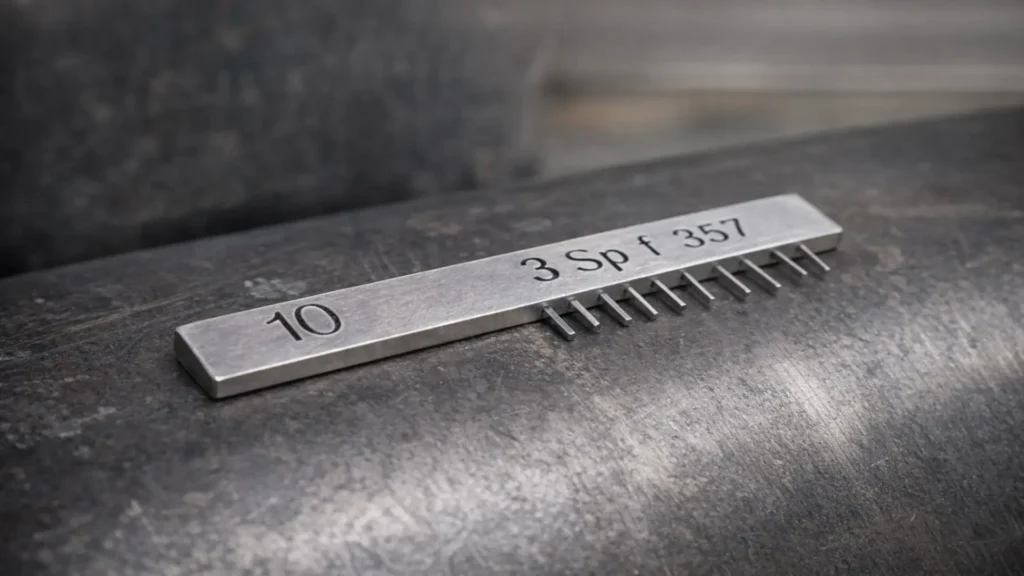
The image quality indicator (IQI) demonstrates sensitivity under real conditions. It avoids decisions based solely on appearance, especially in digital imaging, where visualization can be improved without changing actual performance. Radiographic testing is validated because the IQI demonstrates that the technique achieved the sensitivity required for that material, thickness, and configuration.
IQI as Defensible Evidence
Selecting the correct type and size, placing it properly, and recording evidence strengthens audits. It also allows for the comparison of results between different sites and providers. When the IQI is integrated, exposures due to rework are reduced and test repeatability is improved.
ASTM E747 and Radiographic Quality Control
ASTM E747 is associated with the design and use of wire-type IQIs and is usually incorporated when the procedure or the client requires it. Its operational value lies in standardizing the indicator and facilitating comparability between shots. Compliance should not be a mere formality; it must be integrated into the technique, placement, recording, and clear acceptance criteria. This strengthens the defensibility of the radiographic method.
Competency Framework and Traceability
In the industrial energy sector, inspection is executed under frameworks of codes, practices, and competency requirements. The pattern is consistent: competent personnel, controlled procedures, defined criteria, and documentary traceability.
Managing certifications, calibrations, and procedure versions reduces technical and contractual risks. It also reduces dependence on individual criteria when the radiographic test is executed across multiple sites or with various contractors.
A New Model: DÜRR NDT and Digital NDT Radiography
The DÜRR NDT interview at PANNDT 2025 serves as practical evidence of a common shift: moving from simply “taking radiographs” to governing a digital radiography system with consistent results. Their implemented model is based on:

D-Tect X: Consistent Evaluation in RT
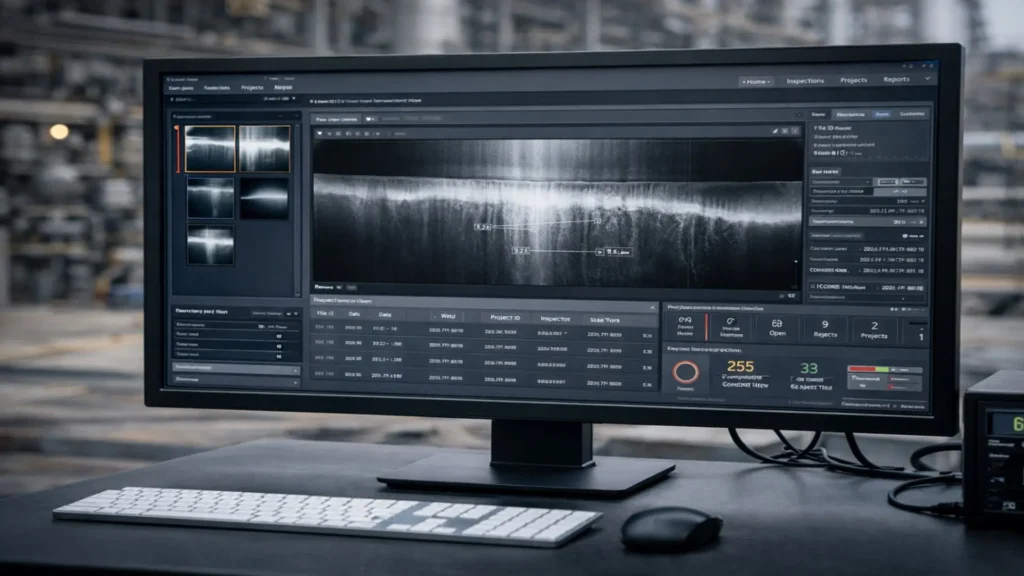
Designed to optimize image interpretation in industrial environments. The software allows for precise zooming into specific areas, facilitating the identification of discontinuity edges. It also incorporates tools for measuring length, width, or area, and an attenuation coefficient module to help detect wall thickness differences.
- Application Example: In practice, two inspectors may interpret the same indication differently without a uniform method for visualization, measurement, and criteria. This often results in rework and unnecessary disputes during acceptance. Using tools like D-Tect X standardizes the evaluation, better defines indications, and reduces subjectivity.
- Operational Impact: The result is clear: faster, repeatable, and technically defensible decisions for QA/QC.
DriveNDT: Multi-site Workflow Control
An operational management platform designed for multi-site environments and distributed teams. With this NDT software, companies can assign tasks to technicians based on their certifications, manage competency expiration dates, control equipment calibrations, and supervise projects from any location.
- Application Example: In multi-site operations, the weak point is not the image, but the execution control: who is inspecting, with what current certification, using which calibrated equipment, and under which procedure.
- Model Insight: DriveNDT is used to assign tasks by certification, track expirations/calibrations, and monitor project status.
- Operational Impact: Fewer audit non-conformities and better process control across multiple fronts.
Flexible X-ray Panels: Access and Productivity
- Application Example: Access limits geometry, and geometry defines sharpness and detectability. With rigid detectors, certain areas force compromises or slow down the work.
- Model Insight: The use of flexible panels to adapt to confined spaces and non-standard geometries is highlighted, facilitating inspections in circumferential joints.
- Operational Impact: Greater coverage with fewer exposures and improved productivity without losing technical control.
DICONDE Standard: Regulatory Compliance
- Application Example: An image without metadata or a standardized file format is difficult to audit, share, or defend. In audits, the question is how it was obtained and how it is controlled.
- Model Insight: Emphasis is placed on compliance with the DICONDE standard and validation with independent software, including reporting, ensuring the archive is traceable and interoperable.
- Operational Impact: Stronger evidence for audits and comparability between sites.
A Comprehensive Proposal for the Future of NDT
Digital radiography is entering a new stage with this work model, where the combination of portability, digital workflow management, and regulatory compliance redefines the execution of radiographic techniques in the field. This change is not just technological; it represents a different way of governing radiographic testing in both field operations and management.
Industrial Radiography: Traditional Model vs. DÜRR NDT
| Key Aspect | Traditional Industrial Radiography | DÜRR NDT Proposed Model |
| Process Focus | Execution of individual radiographic shots | Integrated management of the RT system |
| Image Acquisition | Dependent on operator and equipment | Standardized and controlled digital acquisition |
| Image Evaluation | Variable interpretation between inspectors | Consistent evaluation via specialized software |
| Sensitivity Control (IQI) | Occasional use, sometimes as a formality | Systematic IQI integration as technical evidence |
| Post-processing | Uncontrolled adjustments | Clear governance of permitted post-processing |
| Documentary Traceability | Dispersed or incomplete records | Structured and traceable digital archive |
| Compliance | Dependent on local procedures | Aligned with ASTM E747 and DICONDE |
| Multi-site Management | Difficult to coordinate between sites | Centralized and controlled workflow |
| Competency Control | Manual or partial tracking | Task assignment based on active certifications |
| Test Repeatability | Variable based on operator and setup | High repeatability across equipment and sites |
| QA/QC Impact | Potential acceptance disputes and rework | Faster and more defensible decisions |
| Operational Value | Fulfills inspection requirements | Reduces variability, rework, and decision times |
Conclusions
Radiographic testing remains irreplaceable within QA/QC and mechanical integrity programs, providing objective, traceable, and technically defensible evidence for the evaluation of internal discontinuities. Its validity does not depend on whether the format is analog or digital, but on the correct governance of critical variables, the demonstration of sensitivity via IQI, and rigorous compliance with standards like ASTM, which guarantee reliability and regulatory acceptance.
Digital radiography represents a significant operational evolution by reducing inspection times, rework, and decision-making latency. However, its sustained value is only realized when integrated into a robust management model. The experience driven by DÜRR NDT, analyzed by Inspenet, demonstrates that process standardization, documentary traceability, and technical system control allow industrial radiography to scale in demanding environments, strengthening technical confidence and operational efficiency.
Content developed by Inspenet, the digital platform that connects problems, solutions, and knowledge to keep the world producing!
References
- ASTM International. ASTM E747: Standard Practice for Design, Manufacture, and Material Grouping Classification of Wire Image Quality Indicators (IQI) Used for Radiology. ASTM International.
- ASTM International. ASTM E2339: Standard Practice for Digital Imaging and Communication in Nondestructive Evaluation (DICONDE). ASTM International.
- ASNT. Recommended Practice No. SNT-TC-1A: Personnel Qualification and Certification in Nondestructive Testing. American Society for Nondestructive Testing.
- ASME. Boiler and Pressure Vessel Code. American Society of Mechanical Engineers.
- API. Recommended Practices and Standards for Inspection and Integrity. American Petroleum Institute.
- Video de Inspenet. “DÜRR NDT” impulsa la radiografía digital END con innovación flexible
Frequently Asked Questions (FAQs)
What does industrial radiography detect?
Industrial radiography is especially effective at detecting volumetric discontinuities such as porosity and inclusions. In welds, it can also reveal lack of penetration or lack of fusion, depending on the geometry, radiographic setup, and the specific technique applied.
When is X-ray testing recommended?
X-ray testing is recommended when traceable evidence and rapid decision-making are required in QA/QC. Its performance depends on controlling energy, geometry, and scatter, ensuring system sensitivity is validated through IQIs.
What equipment is used in industrial radiography?
Industrial radiography combines a radiation source (X-ray or Gamma), a detection system (CR or DR), and evaluation and archiving software. Selection depends on material thickness, accessibility, and traceability requirements.
What is an IQI in radiographic testing?
An IQI is an indicator that demonstrates the actual sensitivity of the radiographic system under inspection conditions. It verifies that the applied technique is valid, repeatable, and defensible during quality audits.
What is the purpose of the ASTM E747 standard?
The ASTM E747 standard is used as a reference for the design and application of wire-type IQIs. It facilitates comparability between radiographic takes, equipment, and different sites when required by procedures or the client.
What are the risks of post-processing in digital radiography?
Post-processing can improve image visualization, but if uncontrolled, it introduces interpretation variability. Therefore, permitted adjustments must be defined while maintaining the traceability of the original radiographic file.