
Table of Contents
- The new scale of turbines and its mechanical implications
- Lifetime-based design paradigm vs. static margins
- Innovations in wind turbine bearings
- Main types and technological evolution
- Innovation in materials and design
- Split technology: optimizing maintainability
- Structural control and operational dynamics
- Conclusions
- References
- Frequently Asked Questions (FAQs)
Modern wind turbines operate at the limits of mechanical engineering. With capacities already exceeding 15 MW in onshore applications and projections reaching 25 MW in offshore environments, rotating components are subjected to unprecedented load, fatigue, and temperature conditions. In this context, high-performance bearings have evolved from functional elements into critical components for the structural and operational reliability of wind turbines.
This scenario has driven a transformation in both the design and management of these systems. On one hand, there is a significant evolution in materials, geometries, and bearings configurations. On the other hand, maintenance has shifted toward predictive approaches supported by artificial intelligence, continuous monitoring, and asset digitalization. The growth of the global wind bearings market, projected to reach USD 8.624 billion by 2032, reflects this transition toward more advanced, intelligent solutions focused on extending service life.
This expansion is not only quantitative; it represents a qualitative transformation toward smart bearing systems, advanced engineering materials, and maintenance methodologies that are redefining availability and service life standards in wind farms.
The new scale of turbines and its mechanical implications
The growth in size and power of wind turbines has redefined the limits of mechanical design. Today, turbines that were considered large-scale a decade ago have been surpassed by configurations that double their capacity. This change not only implies an increase in dimensions but also a profound transformation in structural demands.
The loads acting on main bearings increase nonlinearly with rotor diameter, reaching values above 50 MN in the largest configurations. At the same time, bending moments generated at the blade root and transmitted to the tower require increasingly sophisticated fatigue analyses. The extension of design life to ranges of 25 to 30 years, combined with exposure to highly aggressive offshore environments, introduces new variables that directly affect material degradation and system reliability.
Lifetime-based design paradigm vs. static margins
From traditional design to a lifetime-based approach
The design paradigm has evolved from approaches based on static safety factors to methodologies oriented toward service life. This shift responds to the need to understand material behavior under millions of variable load cycles, where fatigue phenomena dominate the failure process.
The current paradigm focuses on lifetime-oriented design, which incorporates:
Load spectrum analysis: statistical modeling of wind regimes and their translation into stress histories using methods such as rainflow counting to evaluate accumulated damage according to Miner’s rule.
- Damage Equivalent Loads (DEL): a metric that compresses the full spectrum of variable loads into a constant-amplitude load that produces the same fatigue damage, facilitating comparisons between control and design configurations.
- Coupled aeroelastic simulations: tools such as OpenFAST (NREL), HAWC2 (DTU), and Bladed (DNV) simulate the coupled dynamic behavior of the structure under turbulent wind conditions, enabling high-resolution load quantification for each component.
- LCOE-driven design: the Levelized Cost of Electricity (LCOE) serves as an integrative criterion balancing initial investment, energy efficiency, operation and maintenance costs, and service life. Fraunhofer ISE projects onshore wind LCOE values of 3.7–9.2 ct/kWh by 2045 in mature markets.
Innovations in wind turbine bearings
A modern wind turbine incorporates between 13 and 20 critical bearings. Each operates under radically different conditions: the main shaft bearing supports the most severe loads in the system; pitch and yaw manage slow movements under enormous and alternating loads; gearbox operate at high speed with complex dynamic loads. A deep understanding of each category is essential for rotating equipment specialists.
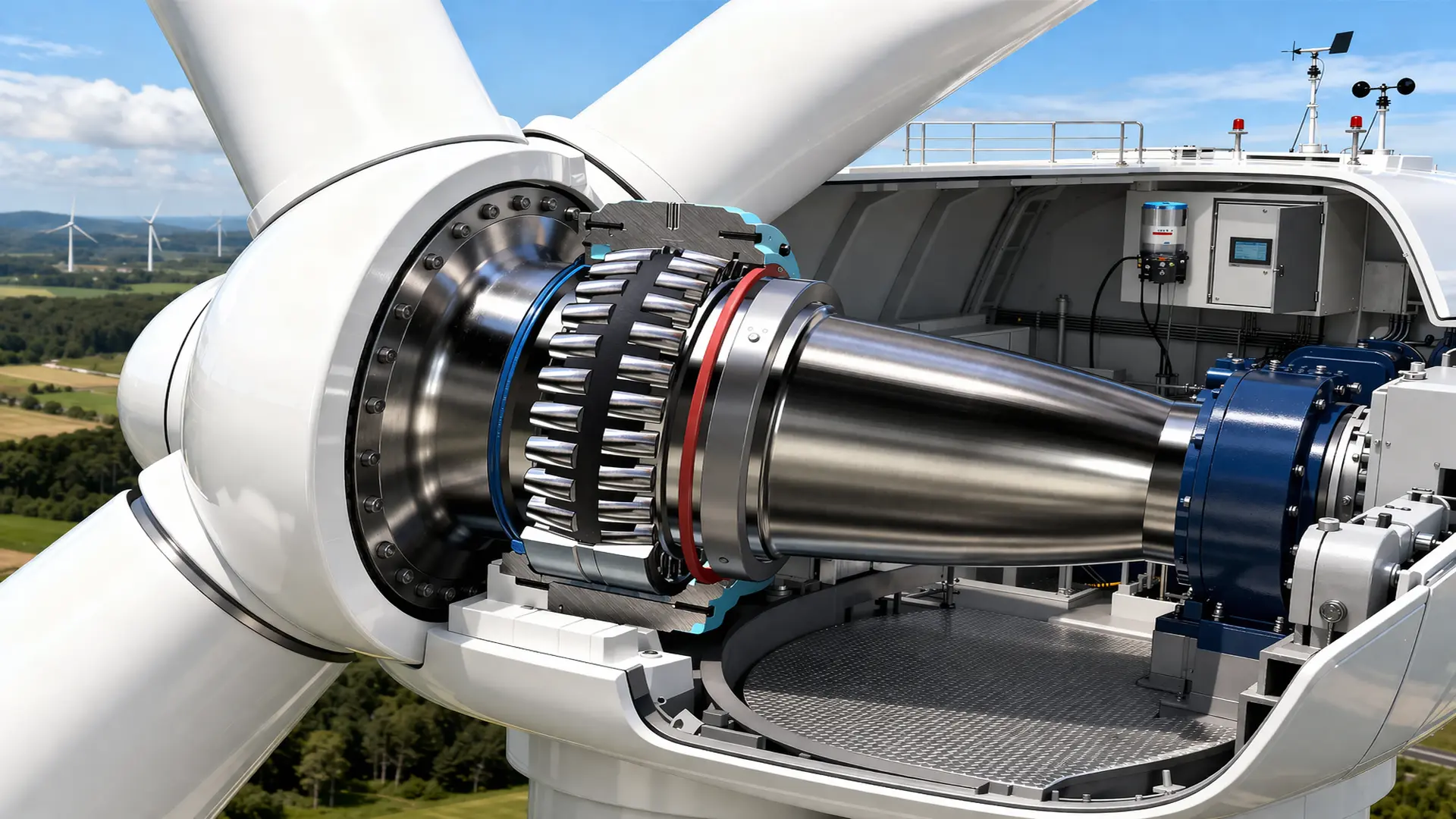
The main shaft bearings represents the most critical element in the drivetrain. Its function is to support rotor weight, aerodynamic loads, and bending moments while enabling efficient rotation. Historically, spherical roller have dominated this application due to their ability to tolerate misalignment. However, issues associated with subsurface fatigue failures have driven the adoption of tapered roller, which offer better load distribution and greater structural stiffness.
In parallel, pitch and yaw systems introduce different challenges associated with low-speed oscillatory motion under high loads. These conditions favor phenomena such as fretting wear, surface fatigue, and stick-slip effects, which directly impact bearings service life.
Main types and technological evolution
Spherical roller bearings (SRB) have historically dominated main shaft applications due to their versatility: they can act as both locating and non-locating and can accommodate angular misalignment.
However, recent studies reveal persistent reliability issues in main shaft SRBs, associated with subsurface fatigue failure modes and white etching cracks, whose root causes are not yet fully understood or resolved.
Tapered roller bearings (TRB) are gaining ground due to their superior ability to support multidirectional loads. Their versatility is recognized in scientific literature (2016–2024) as the reason they are the most studied type in academic research. The double-row tapered bearing configuration in face-to-face arrangement (DRD) provides superior stiffness and improved load distribution.
Designs representing significant conceptual advances include:
- CARB toroidal bearing: specifically designed to function as a compact non-locating bearing, with excellent accommodation of axial displacement and reduced axial forces induced by deflection.
- Asymmetrical spherical roller bearing (ASRB): optimized for balanced load distribution in main shaft configurations, with asymmetric contact geometry that enhances dynamic load capacity.
Smart bearings and continuous monitoring
One of the most relevant advances in recent years is the incorporation of embedded sensors in bearings. These systems enable real-time monitoring of key variables such as vibration, temperature, and lubricant condition, generating data that can be analyzed to detect anomalies and anticipate failures.
The integration of this data into digital platforms facilitates the implementation of predictive maintenance strategies, where decisions are based on the actual condition of the equipment. This approach reduces uncertainty, optimizes resources, and improves the operational reliability of wind farms.
Pitch and yaw bearings
Pitch and yaw systems constitute the aerodynamic control and orientation subsystems of the turbine. Their bearings are large slewing rings that can exceed 4 meters in diameter in next-generation turbines.
The most challenging characteristic of these bearings is their operating regime: small-amplitude oscillations at low speed under enormous and variable loads. This regime generates phenomena such as:
- Fretting wear: the raceway is not fully renewed in each cycle, accumulating wear particles that act as abrasives.
- Surface contact fatigue: Hertzian contact pressures in large-diameter configurations generate subsurface stress fields that initiate cracks.
- Stick-slip effects in the yaw system: discontinuous nacelle motion generates load impulses that increase fatigue loads on yaw drive gears and associated bearings.
Aerodynamic control in wind turbines is essential for managing wind-induced loads and ensuring the structural integrity of the system. Through advanced control systems, the generator and the pitch angle of the blades are continuously adjusted to maximize energy efficiency, limit mechanical stresses, and prevent overload conditions.
This control is performed individually on each rotor blade in real time, enabling a precise response to variations in wind speed and direction.
The following video, courtesy of Grafische Werke Stuttgart, presents an application that illustrates how these control systems operate in modern wind turbines controlled by Moog generators.

Pitch Control.
Smart bearings
The most transformative innovation in the past two years is the emergence of intelligent bearings, where instrumentation is directly integrated into the component rather than added externally.
In 2024, more than 290,000 sensor-integrated bearings were delivered for wind applications. These systems include:
- Three-axis accelerometers for real-time vibration analysis, capable of detecting anomalies at characteristic frequencies (BPFO, BPFI, BSF, FTF) associated with failures in the outer race, inner race, rolling element, and cage.
- Precision temperature sensors (PT100 thermistors or RTDs) integrated into the raceway to detect early thermal anomalies before visible damage occurs.
- Lubricant condition sensors measuring particle contamination, relative viscosity, water content, and oil oxidation.
- Wireless data transmission using industrial protocols (IO-Link, industrial Bluetooth LE, WirelessHART) directly to the turbine SCADA system.
Innovation in materials and design
The development of advanced materials has been essential to improving bearings performance in demanding environments. The incorporation of ceramic rolling elements combined with high-strength steels has increased service life in offshore conditions, where corrosion and electrical currents are critical factors.
Similarly, the use of specialized coatings and polymer cages has reduced friction and improved thermal stability. Design innovations such as split bearings have significantly improved maintainability, reducing intervention times and associated operational costs.
Next-generation materials and coatings
Material evolution in wind turbine bearings is one of the most active innovation fields, with more than 560 new models introduced in 2023–2024 for turbines above 6 MW.
| Innovation | Application | Quantified Benefit |
|---|---|---|
| Hybrid ceramic bearings | 48,000+ offshore turbines (2024) | +23% service life in saline environments |
| Fluoropolymer coatings | Pitch and yaw bearings | Operation from -55°C to +110°C |
| Advanced polymer cages | Main shaft and gearbox | Reduced friction and weight |
| Ultra-high-strength steel | Main bearings 15+ MW | Higher dynamic load capacity |
| Split design (inner ring) | Onshore spherical bearings | -50% replacement time |
| New housing geometries | 170,000+ upgrades (2024) | -14% weight through compact design |
Hybrid bearings, with silicon nitride (Si₃N₄) rolling elements and special steel rings, offer decisive advantages for offshore applications: resistance to electrolytic corrosion, lower thermal expansion, higher hardness and impact resistance, and elimination of harmful electrical currents induced by generators. Saltwater immersion tests confirm a 23% increase in operational service life.
Split technology: optimizing maintainability
The split design (inner ring split) represents a highly valuable practical advancement for remote wind farm operators. The need to dismantle the entire nacelle to replace a main bearing has historically been one of the most costly maintenance operations, exceeding USD 500,000 per event in offshore installations.
In 2024, more than 61,000 split spherical bearings were installed globally, with a documented 50% reduction in maintenance time. This technology is especially valued in markets with logistical challenges such as Chile, Argentina, and Australia, where nacelle access at height represents a significant operational barrier.
Structural control and operational dynamics
The dynamic behavior of the turbine is strongly influenced by the yaw system and blade pitch control. The yaw system ensures alignment with wind direction, while pitch control, particularly in its individual mode, allows each blade to be adjusted independently to reduce asymmetric loads.
Yaw misalignment, even at moderate angles, can generate significant increases in fatigue loads, especially under turbulent conditions. This phenomenon highlights the importance of integrating mechanical design with advanced control strategies to mitigate dynamic effects and extend component service life.
Conclusions
The evolution of wind turbines toward larger power scales has profoundly transformed the role of bearings within the system. These components have evolved from passive elements to key components within an integrated approach combining advanced design, innovative materials, and continuous monitoring.
In this new scenario, the integration of digital technologies and predictive maintenance strategies enables failure anticipation, operational optimization, and improved asset reliability. High-performance bearings are thus established as a strategic element in the sustainability and efficiency of modern wind energy generation.
References
- International Energy Agency. (2023). Wind energy: Market report and analysis. International Energy Agency. https://www.iea.org/reports/wind-energy
- Musial, W., Spitsen, P., & Duffy, P. (2021). Offshore wind market report: 2021 edition. U.S. Department of Energy. https://www.energy.gov/eere/wind/offshore-wind-market-report
- Harris, T. A., & Kotzalas, M. N. (2006). Rolling bearing analysis (5th ed.). CRC Press.
Frequently Asked Questions (FAQs)
Are plain bearings an emerging trend?
The industry is increasingly exploring plain bearings as an alternative to rolling element bearings in the main shaft. Under low-speed, high-load conditions typical of main shaft operation (3–15 RPM), hydrodynamic or hydrostatic bearings may offer advantages in terms of service life and elimination of contact fatigue damage.
What is the global installed capacity?
Global wind capacity surpassed the first terawatt (TW) of cumulative installed power in 2023, with a 13% year-over-year growth according to the Global Wind Energy Council (GWEC). In 2023, 117 GW of new capacity were installed, the highest volume in the history of the industry. By 2025, total global large-scale wind and solar project capacity grew by 11%, from 4.4 TW to 4.9 TW, according to Global Energy Monitor (GEM).